“Decoding Gross Margins: What They Reveal About Moats, Value Creation & Sustainable Long-Term Value”

Peter Thiel, in his book “Zero to One”, wrote that the role of a successful business is to create value in the economy — and then capture a share of that value.
While revenues reflect the value a business is creating in the economy, a contribution margin (profit generated after adjusting for all the direct/variable costs to generate a rupee/$ revenue) or, in crude approximation form, “gross margins”, reflects the value captured by the business.
Thus, A business operating at a higher gross margin captures a larger share of the value it creates in the economy, rather than passing it away to its suppliers, customers, or competitors.
Airline Paradox
Consider airlines; they have fundamentally reshaped global mobility and created multi-billion-dollar businesses. That is extraordinary value creation. And yet, airlines are often considered terrible businesses, operating at thin margins due to intense competition, as demonstrated by numerous global bankruptcies to date.
Thus, creating value and capturing it are two entirely different games.
Moats That Drive Higher Gross Margins?
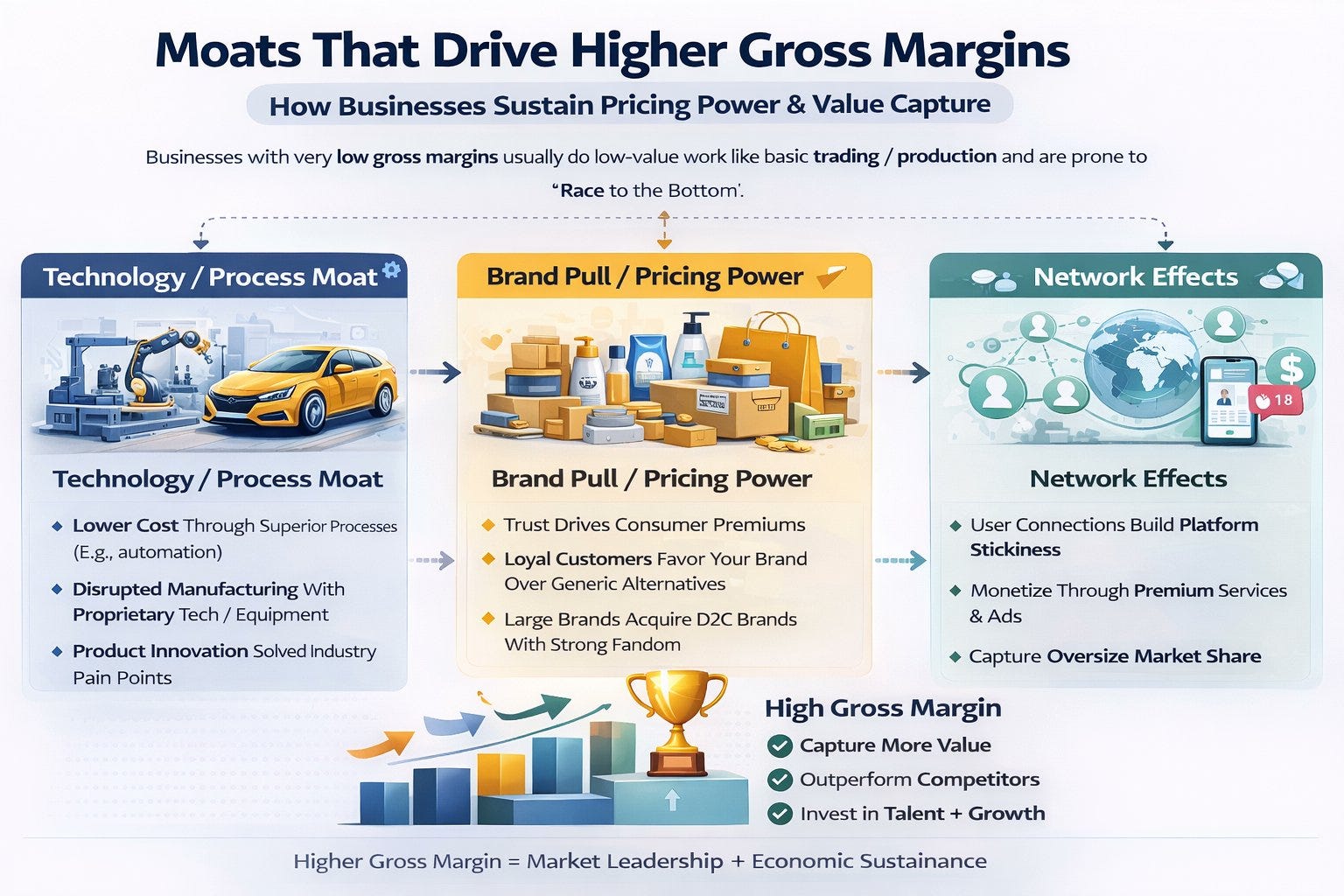
Technology moat - Specific to manufacturing, it could be process-led (really upskilled the way to manufacture a product or disrupted the existing industry status quo of product manufacturing, equipment-led (either developed a new proprietary technology/equipment to manufacture a product) or product-led (created a new solution that solves for the industry’s existing pain points).
Brand Pull - primarily in consumer brands, trust and loyalty built by HUL/P&G allow them to charge a consumer premium over local regional brands, & similarly, new-age D2C brands charge consumers a higher price than HUL/P&G. (Hence, a gold rush by HUL/P&G to acquire these brands.)
Network Effect: Primarily for social media/tech businesses (the network effect enables strong platform retention, allowing companies to charge an exceptionally high rate for services & capture a large share of the value created).
Decoding Current Value Capture Across Power Transformer Ecoystem
To expand on my views on how gross margins are a reflection of the value addition by the business, I decided to dig deep into the power transformer manufacturing value ecosystem & how CRGO steel, a major cost constituent of a transformer, moves across the chain through multiple listed companies.
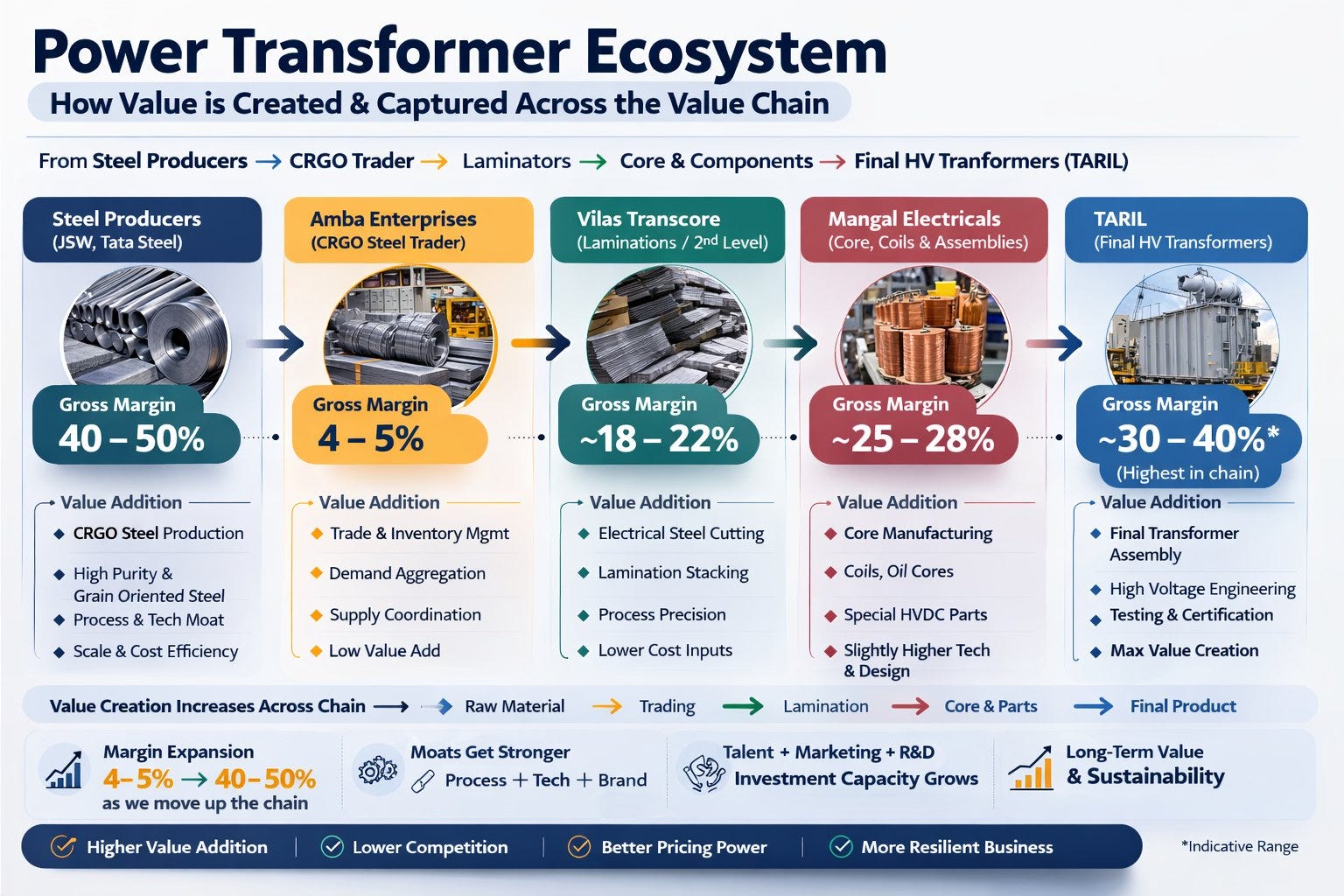
CRGO Steel Producers (JSW/Tata Steel): CRGO steel is produced by major steel producers such as JSW, Tata Steel, which have incurred high capex costs, limited producers, hence on average enjoy high GM% (40%)+.
CRGO Steel Traders (Amba Enterprises): Purely CRGO steel traders, with little value creation/addition in the process, and make approx 4-5% Gross Margin, broadly a market-making spread for demand generation (procuring from steel manufacturers/dealers & selling to lamination slitters/core manufacturers)
CRGO Lamination Slitting & Transformer Core Manufacturing(Vilas Transcore/Mangal Electricals):
At the 3rd level are CRGO lamination slitters/Core manufacturers - they buy the CRGO steel coils, slit them as per the transformer manufacturer’s specs, and deliver them. A very labour-intensive & not so technical, low-value-added work. Hence, gross margins are in 15% range. (a higher value creation than pure CRGO trading, hence higher margins).
They progress further up the chain by manufacturing transformer cores - a slightly higher value-added technical work, hence higher gross margins.
Vilas Transcore - operates as a lamination slitter to low voltage transformers (240KV+), hence gross margin approx (15-20%), however, progressing upwards into transformer core manufacturing.
Mangal Electricals - a competitor to Vilas, caters to transformer cores to the HVDC segment (400KV+), which is a more technical process, hence less competitive & allows for higher value-capturing, hence a higher gross margin, approx 25-30%.
. 4. Transformer Manufacturers (TARIL)
End of value chain - makes the final transformers in the high voltage segment, and hence does the most value creation across the entire power transformer chain and thus enjoys the highest margins across the value chain (30%+)
Even amongst the other transformer manufacturers, its ability to cater to the higher HVDC segment offers less competitive intensity, hence allowing the company to not cede value to its competitors.
How High Gross Margins Fuel a Business’ Long-Term Growth And Sustainability.
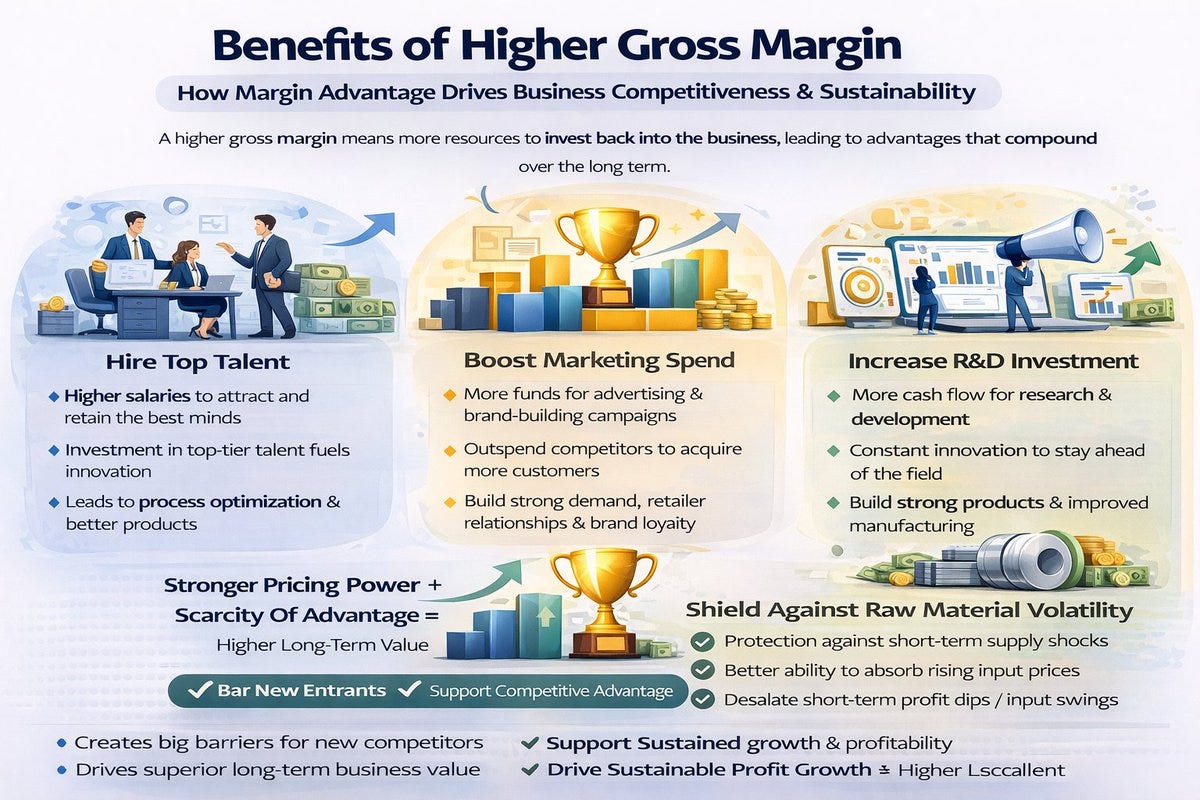
Benefits of assessing gross margin not only reflect the company’s current technical capabilities & industry’s competitive intensity, but it also has a further follow-on impact on long-term growth & business sustainability due to the following reasons.
Hiring Top-Talent - A company is just as good as the team it employs, a higher gross margin fosters a company’s ability to pay higher compensation, thus attracting and retaining top-industry talent, which has further long -term benefits of operation optimisation, sales/business development, R&D & identifying and establishing new growth verticals.
Higher marketing spend - Specifically important for consumer brands, a consumer business is majorly a marketing-first business (specifically D2C biz), thus a higher gross margin generates more cash flows on a product sold to spend on subsequent marketing, thus capture more consumers & further fuel revenue growth. In the case of distribution, a higher gross margin allows flexibility to offer a higher retailer/distribution margin, thus offering a product push at the point of sale.
Higher R&D Spend - While for consumer brands, it allows for higher marketing spend, for manufacturing biz, a higher R&D spend allows for continuous innovation in products & manufacturing processes, which allows for more market share capture or competitive sustainability.
Safeguard against raw material volatility - higher value addition will protect against short-term raw material risk, and further safegaurds company’ ability to pass on any raw material volatility to the consumer. Eg jaybee laminations, and the potential to pass through the cost
Going back to the Power Transformer ecosystem, Jaybee Laminations, a competitor to Mangal & Vilas & operating in the CRGO slitting & core manufacturing space, was a victim of raw material volatility & saw a major margin hit (gross margins went down 10%) due to competitive intensity and inability to pass the higher material cost to transformer manufacturers.
Concluding Views
A business that enjoys a higher gross margin can afford top-notch talent, a higher marketing spend & potential to manage short-term margin hit, which usually forbids a sustainable long-term competition intensity, thus ensuring long-term business stability & consistency, a high terminal value. thus a higher valuation multiple.
I have already written a post on Pricing Multiples & the science behind the multiples, incase interested in reading it, I have shared it below.
